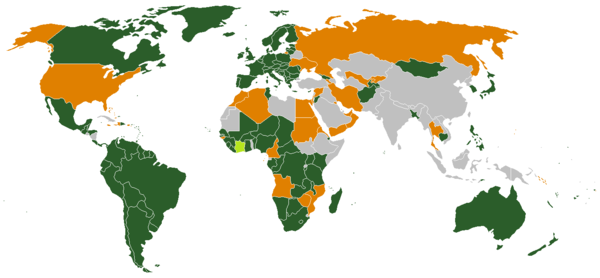
 At a conference on the International Criminal Court yesterday, Pittsburgh Law Professor Charles Jalloh asked Ambassador Stephen J. Rapp to clarify the status of the United States vis-à-vis the Rome Statute of the International Criminal Court. Rapp, who leads the State Department’s Office of Global Criminal Justice, began by recounting the Clinton Administration’s signing in 2000. (credit for map depicting signatories in gold) Next Rapp gave an account of what some have called the Bush Administration’s “unsigning.” He then described to his Emory Law audience the position of the Obama Administration: The United States is endeavoring to advance accountability goals underlying the ICC treaty. Indeed, Rapp reminded, State Department Legal Adviser Harold Hongju Koh more than once had made this same point.
Koh’s most recent affirmation came in “International Criminal Justice 5.0,” a speech delivered in New York and at The Hague in November 2012, a couple months before Koh’s term ended. U.S. ratification of the ICC treaty is not in sight, Koh said then (as did Rapp yesterday). Koh then listed many ways in which the United States has worked in recent years to support the court’s efforts (again, as did Rapp). Finally, Koh recalled remarks he’d given two years earlier, on which IntLawGrrls then had posted. (And see Jennifer Trahan’s OJ post.) Koh quoted the 2010 statement in his speech last November, as follows:
Putting all of this together, as I made clear more than two years ago in a speech at New York University,
“What you quite explicitly do not see from this Administration is U.S. hostility towards the Court. You do not see what international lawyers might call a concerted effort to frustrate the object and purpose of the Rome Statute. That is explicitly not the policy of this administration. Because although the United States is not a party to the Rome Statute, we share with the States parties a deep and abiding interest in seeing the Court successfully complete the important prosecutions it has already begun.”
That phrasing hearkens to Article 18(a) of the 1969 Vienna Convention on the Law of Treaties, which provides that “[a] State is obliged to refrain from acts which would defeat the object and purpose of a treaty when … it has signed the treaty or has exchanged instruments constituting the treaty subject to ratification, acceptance or approval, until it shall have made its intention clear not to become a party to the treaty ….”
In short, regardless of how one characterizes the 2002 letter in which then-U.S. Ambassador John Bolton “inform[ed]” the U.N. Secretary-General “that the United States does not intend to become a party to the treaty” and so “has no legal obligations arising from its signature,” top Obama Administration officials have made clear that the United States now acts toward the ICC treaty as any good signatory should.
 Diane Marie Amann
Leave a reply to Diane Marie Amann Cancel reply